Sunday, August 18, 2013

Pride & Prejudice

"She had dressed with more than usual care, and prepared in the highest spirits for the conquest of all that remained unsubdued of his heart, trusting that it was not more than might be won in the course of an evening."
It's been a long time since the last time I read Pride and Prejudice - most of my ideas about it are really from adaptations (the movies, Lizzie Bennet Diaries), not the book. The adaptations take a more charitable approach to Elizabeth - she might be judgmental, but you never really get the sense that she's prideful. Austen makes this much clearer (see the above quote). She's still a lovable character, but far more human than the spunky proto-feminist I remembered (and by "remembered," I suppose I mean "cobbled together from multiple sources").

I also tend to forget how downright disdainful Austen is toward so many of her characters. And not the wicked ones. The stupid ones and the silly ones seem to be the prime targets of her disdain. I think it's easy for people who haven't really given Austen a chance to write her books off as fluffy romances, but they're much darker than they seem at first glance. There are moments in her books that resemble, more than anything, modern cringe comedy, where the way she presents characters is funny in an uncomfortable way, a way that makes you question, as you laugh, exactly what kind of person laughs at such nastiness.

Saturday, August 10, 2013

Reading differently

I am still reading Consider the Fork. I think when I say it like that, it could come off as frustration, and I really don't mean for that to happen. It is a slower book than the last few I've read, and a different kind of book, and the experience of reading it is different. Not just that it takes longer, although clearly it does. I said last time that it was the kind of book I kept wanting to share tidbits from, and I still feel this way (and I do share tidbits every chance I get). It is also the kind of book I could and would like to dip in and out of. A book I should be reading along with another book (I can't - there isn't time). It's very engaging, but I'm not invested in it.

It's kind of amazing, the vastly different effects that books can have on you. Just comparing this one with Lovely, Dark and Deep, for instance. Consider the Fork has, thus far, made my thoughts spin off into considerations about having a minimalist kitchen, wishes to cook more in the hopes of becoming a more intuitive cook, and dreams of buying new pots and pans. It has also made me feel a little lonely in the sense that I don't always have someone around to recount interesting factoids to. Reading Lovely, Dark and Deep took me in some very different directions indeed (I think what little I wrote about it should make that apparent). It made me consider my own past, lost relationships that I have grieved (may still be grieving), and it made me frustrated because I did and did not want to let all that out. Or something. Reading a book like that is visceral - parts of it are so raw it hurts to read them and it hurts to deal with the mental spaces they rub up against.

I keep thinking about Lovely, Dark and Deep. Much as I'm enjoying Consider the Fork, and despite the high probability that I will be regaling friends and family with trivia from it for years to come, it's not going to stick with me in the same way. And that's okay. It doesn't need to. In fact, it might be good - having every book cling to you in such a persistent, gnawing way would be unbearably heavy. These moments of levity, these palate-cleansers, are crucial.

Sunday, August 4, 2013

Consider the Fork

I didn't actually mean to be quite so depressing with that last post. It was the book, and a week of being mostly on my own, and a very terrible sleep schedule - they ganged up on me. Really, Lovely, Dark and Deep was fantastic. Poetry. Complex, with no easy resolutions (my biggest problem with Jepp was the too-tidy ending), but still deeply satisfying. And with such a distinct sense of place, something I'm always over-the-moon to find in books.

And now I've moved on. Bee Wilson's Consider the Fork: A History of How We Cook and Eat. Non-fiction seemed like a good idea.

I'm still reading the introduction, but it is already the kind of book I want to share, the kind of book where you want someone around who is willing to listen to you read particularly interesting passages aloud because they simply must be shared. For instance:
Open hearths were a major cause of death in Europe, too, for centuries. Women were particularly at risk, on account of the terrible combination of billowing skirts, trailing sleeves, and open fires with bubbling cauldrons hung over them. Professional chefs in rich households until the seventeenth century were almost universally men, and they often worked naked or just in undergarments on account of the scorching heat. Women were confined to the dairy and scullery, where their skirts didn't pose such a problem.
Hilarious! From the mental image of the naked chefs to the absurdity of women continuing to wear billowing skirts, despite the obvious risk. This, I think, is precisely the book I needed. I'm glad to have found it.


Saturday, August 3, 2013

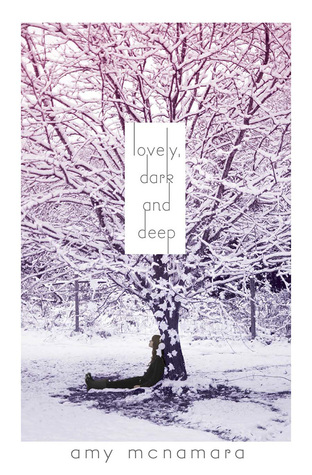
Lovely, Dark and Deep

Turns out I don't have much else to say about Jepp, Who Defied the Stars. I certainly enjoyed it, and I love that it deals with the question of fate versus free will and I can recommend it, but I just don't have much else to offer.

And I'm not sure how much I can say about my next selection, Amy McNamara's Lovely, Dark and Deep. To be honest, I'm a little worried about reading this book. I've plowed through the first 80 pages already and the language is gorgeous and affecting. But the story deals with grief and depression and it plunges you into that so deeply that...yeah, I worry. I can't empathize with Wren's crushing grief, but I'm finding her story to be a little too resonant for this rather lonely girl and I just don't know how smart it is to willingly dig myself into melancholy like this.

Let's be honest, though. I'm not going to stop reading. I just wanted to say out loud-ish that this might be a tough book for me to deal with. And maybe a tough book for other people to deal with, which is maybe an important thing to acknowledge if I'm going to talk about it and/or recommend it.

Wednesday, July 31, 2013

Jepp, Who Defied the Stars

First of all, that title. Don't you want to read it for that? And if not that, then the design, because what a lovely cover! And the end-pages, and the blue text...it may all be artifice, but it is charming artifice.

I've been reading a lot of this book out loud to myself. It slows me down, and there are just some people whose words you want to say out loud. Katherine Marsh is one of those people. I've mentioned before the language of Mervyn Peake in his Gormenghast trilogy - the way he lavishes words on his readers; I don't think Marsh is quite up to Peake's standards, but she doesn't shy away from the vocab. Especially given that this is, ostensibly, a young adult novel (I can see some teen readers struggling with the language, as well as the shifts in time and tense).

At this point, I'm about a third of the way in. Beyond the language, I'm finding the story pretty engaging, although I don't know (at this point) if it would make my year-end top 10 (that's a thing I should do, right?). If it gets really good over the next 200+ pages, I'll be back with more information. Otherwise, next up is probably going to be Lovely, Dark and Deep by Amy McNamara (yes, I'm incredibly bothered by the lack of an Oxford comma there).

Tuesday, July 30, 2013

So Long

How long I've been away, that is. I haven't entirely given up on this (though, let's be honest, I probably should).

I didn't even check to see what the last book I posted about was...it's been far too long to catch up. But the last book I read was this one:

Kristin Cronin-Mills' Beautiful Music for Ugly Children.

It's about Gabe, a trans boy with a serious music obsession, growing up in southern Minnesota. The book follows Gabe's final days of high school and the summer after graduation as he struggles with coming out and being out and tests out his dream of being a radio DJ. 

Let me say first of all that I tend to be a little biased toward books set in Minnesota. I can't help it. That said, it would be a pretty darn good book no matter where it was set. It's an important story to be telling (there just isn't much out there dealing with trans issues for young adults), it avoids a super-easy happy ending (thank God - I was worried that Gabe would get absolutely everything he wanted), and it's relatable, even for kids who aren't dealing with coming out of the closet. I think most of us have felt like the person we know ourselves to be isn't visible to those around us and have been frustrated when our attempts to make other people really see us go awry. 

Honestly, my biggest problem with this book is a pretty nit-picky thing from early on - Gabe and his mentor are debating music and Cronin-Mills offers some simplistic explanations of who these musical giants are. First, I don't like the assumption that Merle Haggard needs to be explained. Second, and more importantly, the explanations discourage exploration. If I didn't know who Merle Haggard was and read an argument about his greatness, I would feel compelled to do a little research and listen to some new music and I might discover something incredible. When you're writing about music, you should make me want to listen to it. (The best example I can give is the way Daniel Handler wrote about Hawk Davies in Why We Broke Up. I wanted to hear his music and understand what Min was talking about and I was kind of devastated to discover that he didn't exist.) But like I said, this is nit-picky and really, it's only a problem in the first chapter. 

In sum, read it. 

Thursday, February 7, 2013

Where were we?

Tuesday night was my first class of the new semester. I told a few people that I was really burnt out on YA, which was partially true, although I think the real truth (as evidenced by today and yesterday, my first sick days of the year) is that I was just straight-up burnt out. Run down. In serious need of a mental and physical BREAK. That said, I was also needed a little break from YA and books in general, which is why it has taken me the better part of two weeks to muddle through Markus Zusak's The Book Thief (I'm still not finished, but the end is nigh). My time has instead been spent at work or burning through three seasons of Downton Abbey. 

So instead of talking about all the books I've read since How I Live Now, which I will get to later (maybe tomorrow), let me instead apologize for abandoning this space and talk about two books that I haven't read recently but have been thinking about, particularly in conjunction with Downton Abbey (and a little bit with my Tuesday night class).

First is L.M. Montgomery's Rilla of Ingleside. I started this blog off by talking a lot about Montgomery, but never got to this book. The reason I've been thinking about it is because it is the only book I can remember reading that takes place during World War I (just like Downton's second series). Because it has a similar level of soapiness as well, I just keep imagining that somewhere along the way, Walter or Jem might have met up with Matthew, Thomas, or William in some trench in France. Silly. Anyway, I also wonder why this is the only book I've read about WWI, especially when I've read countless fictional accounts of WWII. 


So, the other book I've been thinking about is E.M. Forster's Maurice. Again, it takes place around the same time (Forster wrote it in 1914, although it wasn't published until much later) and in the same place and treats on some of the same themes as Downton; namely, being gay in a time and place that wasn't going to allow it, at least not without putting up a fight. I can't help wondering if Maurice came up in the creation of the character of Thomas, though even if it didn't, I can't help associating him and his plight with Maurice's (and hoping, even though he's kind of a bastard, that he'll get a similarly happy ending). 

In relation to class, I can't help wondering if Maurice should be classified as a young adult novel. Certainly, it follows Maurice's young adulthood. (One of our many assignments is to compare a pre-1980 YA novel's treatment of a theme with a more contemporary work - it would be pretty cool to compare a 1914 view of homosexuality with something later.)

Next time, we talk about books I've read recently. I promise.