Tuesday, December 18, 2012

4 Books

Let's do this quick and dirty, shall we?

Oh my, how I loved David Levithan's Boy Meets Boy. I'm not sure I can say much about it, because I don't want to say it wrong. The romance between Paul and Noah is delightful (and I swooned when Paul described Noah as his "until"). This book made me cry more than once, but especially when Tony stood up to his mom and then broke down...it killed me. Seriously. I can't talk rationally about this book at all. I loved it. Let's move on...

...to Dreamland, by Sarah Dessen. Dessen is a really popular author in our library, but before this, I didn't really know much about her. I just assumed, from the girls who were checking out her books and the incredibly generic cover art, that she was writing inconsequential romances. Which was not great on my part - I can admit it. It took me a while to really get into this book. Until about halfway in, I really didn't like any of the characters (except Boo and Stewart) and I was annoyed with Caitlyn (it's never good to find your narrator annoying). I didn't get her fascination with Rogerson (and his name is Rogerson, for crying out loud), or why she wanted to spend time with him on drug runs and getting high (to be honest, I'm still not totally clear on that). The second half was like an entirely different book - maybe it was intentional, lulling the reader into the same stupor that Caitlyn found herself in, only to smack them awake and leave them white-knuckled and anxious for the rest of the book. Because seriously, the second half of the book was a psychological thriller, and Caitlyn's terror and shame were palpable. As frustrating as the first half was, I still think this is a pretty good book, and an important topic.

Side note: Dreamland was published when I was in high school, making me approximately Caitlyn's age. So many of the little details were particularly familiar and weirdly nostalgic.

Not a book for class (the other three are). I just really wanted to read it. Erin Jade Lange's Butter is about an obese (423 lbs) teen who decides to kill himself by eating himself to death, live on the internet. For all of that, it is surprisingly uplifting. I'm not sure what else to say about it, without giving a lot away. I liked that the characters were fairly complex - the narrator, nicknamed Butter after a cruel incident of bullying, is not always likable; the bullies are not always horrible. I thought the ending was a little trite, but I have very few complaints otherwise.

Last, and, sorry to say, least, is Twilight. I had vowed to skip this one, so imagine my dismay when it turned up on my class reading list. Ugh. It is 75% dragging and tiresome, with about 25% halfway decent story buried within all that. It would benefit greatly from some ruthless editing. And from a lot less creepiness and traditional gender norms. Blergh. I don't usually think about the length of books, especially YA books. In fact, there are a lot of 500-700 page YA books that I can get through in a day or two. I read this one fast, but it felt loooooooooooooong.

Friday, December 7, 2012

Seventeenth Summer

There hasn't been a lot of free time for reading in the last couple weeks (and there will be even less between now and next Saturday - thank you, graduate school), but I did manage to finish Maureen Daly's Seventeenth Summer. It's another book for my class next semester, so documenting some thoughts about it is the responsible thing to do. Even without that, I'd still want to talk about it. So here we go...

Seventeenth Summer was written in 1942. Maureen Daly was in college when she wrote it; the author bio at the end of the book (which must be the original) charmingly remarks that because she was so young, Daly "recaptured with extraordinary freshness and sensitivity an experience that, because of its very nature, no older author can touch." I could point to some contemporary YA fiction written by fully-grown adults that would contradict that statement, but whatever. I really wanted to focus on the 1942 thing. The cover to the left is the one I have, from a 2010 printing. It looks like the cover of any Sarah Dessen or Deb Caletti book and hides the 70(!)-some years separating it from those contemporary authors. Of course, that age gap becomes almost immediately clear when you actually start reading - you are shoved headlong into the 40's, where cigarette smoking was de rigueur among teenagers, where kissing was risque, where people seriously debated the necessity of bread delivery, since so many people were still baking their own bread. It's kind of like Mad Men, without the self-awareness and wink-wink sexism (I like Mad Men and I can't wait to get caught up on the fifth season, but pushed up against something like this, actually created in a past decade, it can seem rather painfully artificial).

For the most part, I found Seventeenth Summer to be old-fashioned without becoming dated, which is a compliment. It is sweet without being saccharine, and Daly makes moments of Angie and Jack's fairly chaste courtship seem just as breathless as any contemporary YA romance. Though their relationship is innocent, the book itself is surprisingly sensual. It is as much a story about a season in a very specific place as it is about a teenage romance during that season. Angie and Jack's romance is linked to the natural world, growing and ripening just like summer tomatoes. Jack and Angie's first conversation happens in the vegetable garden in early June: "The little tomato plants were laid flat against the ground from last night's downfall and there were puddles like blue glass in the hollows." Their early relationship is as fragile and fresh and miraculous as those new vegetable plants. And it ends where it began - on a late-August night, with frost predicted, Jack and Angie go out to salvage as many tomatoes as they can:
Most of the green leaves were dead and the knobby vines were already wet with night dew. We worked side by side, not talking at first, feeling about in the half-darkness for the tomatoes, and soon our hands were wet to the wrists and the rough wool of my sweater chafed. Even my fingers felt stiff. But somehow it was so natural to be working beside Jack that I didn't want to stop, even for a moment.
I really enjoyed how grounded this book was. The way Daly describes those different hallmarks of summer - how the lake changes as the summer wears on, eating wild grapes in the dark, the arrival of the swallows on the telephone wire heralding the end of summer - made me feel summer. I can't really explain beyond saying that it reminded me in that way of Lauren Oliver's Delirium, which I assure you is a high compliment (it wasn't just the sensuality - Oliver's world is also incredibly chaste, though for sci-fi reasons). It also made me a little sad that my sense of time passing is not as linked to the natural world (though feeling of seeing the swallows on the telephone wire was achingly familiar). By the by, it also reminded me of Barbara Kingsolver's Animal Vegetable Miracle. All three books transported me, in a very specific way...and I can't explain it any better than that.

(We won't write analyses in this class I'll be taking, but if we did, this might be the book I'd choose to write about, with a focus on the parallels between Jack and Angie's relationship and the evolution of summer.)

Saturday, November 24, 2012

Yikes.

Let me just say, it's been a busy month. Not a great excuse, but its all I've got. I've had a lot of projects for class, plus outside plans, plus Thanksgiving and all of its attendant activities...there hasn't been much time for reading or writing about reading. That said, I have read a couple of books since the 7th (can it really have been that long?).

So we'll start with James Dashner's Maze Runner prequel, The Kill Order. It takes us back as far as the first day of sun flares and follows a kid named Mark and the rag-tag group he takes up with through their first post-apocalyptic year. The appearances by recognizable characters are few and far between - in fact, if you took out the prologue and epilogue, this book could exist as a standalone novel. A really violent, depressing standalone, but still. That's my basic takeaway - it's a grim, violent book that does not hold out much hope for the future. It does move incredibly quickly and does not let up. Of the three Maze Runner books, it reminded me most of my favorite, The Scorch Trials. Overall, it's not a bad addition to the trilogy, although it didn't answer as many questions as I would have hoped.

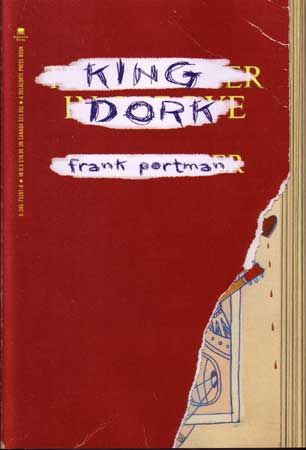
The second book was Frank Portman's King Dork. This is one of those books for class, so I feel like I should have some really insightful things to say about it...we'll see. In my hunt for a picture of the cover, I came across an article about casting for the movie version (Nick Offerman...I'm there). This article included the Amazon summary, which is kind of misleading, so let's start there. This is not a book about a nerdy guy whose life is changed when he discovers the book The Catcher in the Rye (though you might be forgiven for thinking that was the case if you only look at the cover). It's about a nerdy guy who is plenty familiar with TCITR and is, in fact, not a fan. His life is changed when he finds his deceased father's copy of the book and by the notes his father wrote inside.

King Dork does parallel TCITR in some key ways - it's told in a first-person style, with Tom (aka King Dork, Chi-Mo, Moe, etc.) narrating; like Holden, Tom thinks that most people aren't really worth his time (he scoffs at Holden for calling them "phonies," then dubs them all "psycho normals"); Tom is dealing with the early death of his father, much like Holden is still dealing with the death of his brother Allie.

Okay, my computer is acting up. There may be more on King Dork later.

Wednesday, November 7, 2012

4 Books

I'm going to keep this quick and dirty because we've got a lot to get through and not a lot of time (I MUST go to bed - I was up until what Anne Shirley would call the "wee sma's" watching election results come in). So, since last we spoke, I've read four books. Without further ado...

1. Beth Revis' Across the Universe. This book is a mix of a few different genres, but it's mostly science fiction. I find the cover rather misleading - there is romance, but it takes a backseat everything else that's happening (though I suspect the relationship between Amy and Elder will play a larger role as the series goes on). I loved when this book slowed down and focused on the ideas of leaving Earth, of completely severing one's self from a specific time and place and people, of what it would be like to be trapped inside for an entire life, of the power of hope...really lovely and thought-provoking. And the moment when Amy is asked to describe Earth to some of Godspeed's residents and she shuffles through her memories looking for a place to begin, settling finally on the sky (which none of the people she's speaking to have ever seen)...it brought tears to my eyes. I hope to find time for the sequel, A Million Suns, which I got for our library today.

I am a big fan of A Series of Unfortunate Events, so I was delighted to learn, just days before its release, of this prequel series, starring a 13-year-old Lemony Snicket. It did not disappoint. Who Could That Be at This Hour? was sly and funny and suspenseful. It's filled with in-jokes for fans of ASOUE - I laughed out loud at Lemony's frustration with having words constantly defined for him, as well as his insistence that there is simply no time for moping. The book utilizes a noir-ish style beautifully - I would love to pair this book with Veronica Mars (especially the early episodes) and Marissa Pessl's Special Topics in Calamity Physics. Also, the illustrations (as you can see from the cover) are awesome.


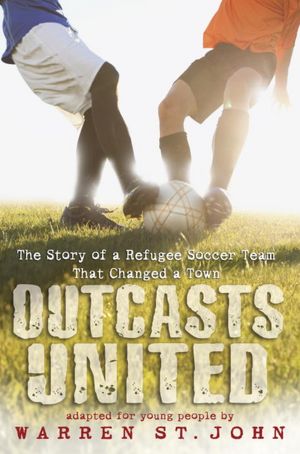
I have recently found myself frustrated with how dated all of our soccer books are (we just got yet another copy of a book about soccer superstars which still has Torres playing for Liverpool, Drogba at Chelsea, and Rafa Marquez at Barcelona). So when I saw this book, I thought it would be an awesome addition to our collection. And indeed, having read it, I'm really happy with the purchase. This is the true story of a children's soccer program made entirely of recent refugees from a smattering of war-torn countries. The stories of these boys will break your heart and their courage and good will and the way they come together, not to mention their coach's tremendous determination and perseverance will pick your heart up, put it back together, and then make it grow three sizes. Very early on, the author describes watching a kid who isn't so good make a really good block, then watching his teammates surround him like he just scored the winning goal in the World Cup. With my eyes filled with tears, I was completely sold.

This book surprised me. I was really prepared to be annoyed by it - the picture thing seemed like a gimmick and...I don't know. I judged it by it's cover. Whatever. But I'm willing to admit my mistakes, and boy, did I ever make a mistake not reading this a year ago! I don't know what I was expecting, but it wasn't this. It wasn't this twisting tale that seems like a supernatural story, then maybe a Holocaust story or a story about a father and son and then whips back to supernatural tinged with all of the above...I liked it a lot. And the pictures really were a nice addition. They probably weren't always necessary, but they really added to the atmosphere, especially (for me) the ones of the wights. They gave me the shivers, especially (for whatever reason) the one of the bus driver with the staples. Creepy. I'll be looking for the sequel.


Saturday, October 27, 2012

The Twelve

Okay. I finished this a few days ago. I didn't want to write about it immediately - so often when I do that, I can't come up with anything to say. I had hoped to let my thoughts about this book marinate (while working on a few other books at the same time) - we'll see how it went.

I should start by talking about The Passage, which is the first book in this trilogy. If you haven't read The Passage, you should get on that, both because it is awesome, and also because most of what I say from here on out will make little sense without the context of that book. Let me be clear, there is very little attempt in The Twelve to bring new readers up to speed or even to remind old readers of what happened in the first book. It didn't really bother me - I've always hated the rehashing books in series do during the first chapters (and often skip them entirely) and I've read The Passage three times (I think). I know the story pretty well. (That said, there were a few things that tripped me up too - if you read The Passage when it came out and never again, getting back into Cronin's world might be kind of tough.) Anyway, like I said, I think The Passage is pretty delightful (if your idea of delightful involves zombie vampires). It's a great book for a long weekend, to be devoured in big gulps - if you stretch it out too long, you might start forgetting where everyone in the sizable cast of characters fits into the storyline that spans a century. This devouring isn't hard though - once you get into the story, it's hard to pull yourself away.

I suspect it would be best to read The Twelve this way, too. I didn't really do that because I was just so excited - I started it as soon as I got it home and read it whenever I could sneak it in. The Passage ends on a cliffhanger and I expected to pick up from there with this book, but that isn't the case. Instead, we get a brief check-in with Amy and Alicia, then are dumped back into the past to meet some strangers from the old days. I was surprised to find that Lila Kyle, ex-wife of Brad Wolgast (surrogate father to Amy) played such a large part in these early chapters (and, of course, in the later story) - in The Passage, she was little more than background, an archetypal character to explain why Wolgast was the way he was. In The Twelve, she is an entirely different kettle of fish. Seriously. A weird, weird duck, all the way (deliciously creepy in her delusions).

I won't try to summarize - with this sprawling cast and epic scope, it would take me all night. But I can say without reservations that I really dug this book. It's dark and creepy, with plenty of sequences that will leave you breathless; it also has moments that will bring you to happy tears. If you liked The Passage (and again, I cannot emphasize how much you need to read that before picking this up), you'll enjoy this.

Next up: Oh boy. So, I checked out three books right before I bought The Twelve - from the YALSA Top 10, Across the Universe and Miss Peregrine's Home for Peculiar Children, as well as James Dashner's Maze Runner prequel, The Kill Order (I have mixed feelings about this trilogy as a whole, but I frakking loved The Scorch Trials, so I have high hopes for this one). Obviously, they fell by the wayside when I got The Twelve. When I finished The Twelve, I started in on Across the Universe. Then I went book shopping (for the library - one of the best things about my job) and bought the new Lemony Snicket book, Who Could That Be At This Hour? It was irresistible. Across the Universe set aside, Lemony Snicket picked up. Also, today I got my reading list for the YA Lit class I'll be taking next semester; when the aforementioned books have been read (also, Outcasts United, another of my shopping purchases), expect to start hearing about those.

Whew!

Tuesday, October 23, 2012

Perks

Right now, I'm in the middle of reading Justin Cronin's The Twelve. I will for sure write about that when I'm done with it, but in the meantime I thought I'd talk about The Perks of Being a Wallflower, book and movie.

I saw the movie last Wednesday (with a friend who had never read the book). I was periodically distracted by Emma Watson's British-ness occasionally poking through, but beyond that, I thought the adaptation was good. The casting was pretty spectacular (really, if you put Paul Rudd and/or Mae Whitman in just about anything, I am likely to enjoy it), and Ezra Miller is a real find. That said, I think I'm just too familiar with the book to say much about the movie. I know things have to be cut for the sake of time and again, it's a good adaptation (and should be, given Stephen Chbosky's involvement). But. I don't think I could be truly satisfied with anything that isn't the book itself.

I actually re-read the book about a month ago and never wrote about it here. It's a book I've read more times than I can remember - actually, I don't remember when I first read it. Mostly, all of my other memories of this book are subsumed by the memory of reading it during my freshman year of college. It was spring break and I stayed on campus, so it was painfully lonely and snowing the whole time and so cold in my dorm room and I read the book twice (because I was apparently feeling masochistic). Also, I had just gotten a perm (not a gross tight one) and my hair still smelled like the stuff they use to make the curl last. I guess I remember that time so well because my mood was already so appropriately matched to the mood of the book and because I associate that bone-deep cold and the perm smell so strongly with that feeling and that moment in time. In fact, I got my hair permed at least once after that and it took me a couple of days to realize why the smell was depressing me so much. Anyway, that's what comes rushing back every time I read this book. And because I associate it so much with all of that, it's hard for me to say much else about this book and hard for me to have any critical and well-expressed thoughts about the movie.

Monday, October 15, 2012

The Graveyard Book

It's hard to find things to say about the good books. I mean, this won the Newbery a few years ago - do you even need a recommendation from me?

All I can really do is add my voice to the chorus, so here goes:

I just loved this book. It was a perfect blend of scary and magic and heart and melancholy (and yes, I know that list is poorly composed). I was wary at first because opening with a triple homicide seemed a little too In Cold Blood for a children's book, but really, I was sucked in before I had time to get too worked up about it. The illustrations were perfect, the characters fantastic...

My favorite part was a chapter called "The Danse Macabre." It pushed me over from really liking this book to kind of loving it - that chapter just cast a spell on me. I also loved the ending, which made me cry, and Gaiman's Newbery acceptance speech (in the back of the copy I was reading), which made me cry more.

This is pretty much incoherent, but I feel like I warned you at the get-go. I just can't talk about the really good books; at least, I can't be objective about them. I can sometimes talk about my experience of reading them, or identify quotes and passages that really gripped me, but I can't say much about them that is intelligent. And I'm comfortable with that. In fact, I'm downright happy that there are so many books in this world that leave me fumbling for words.